
Quick answer
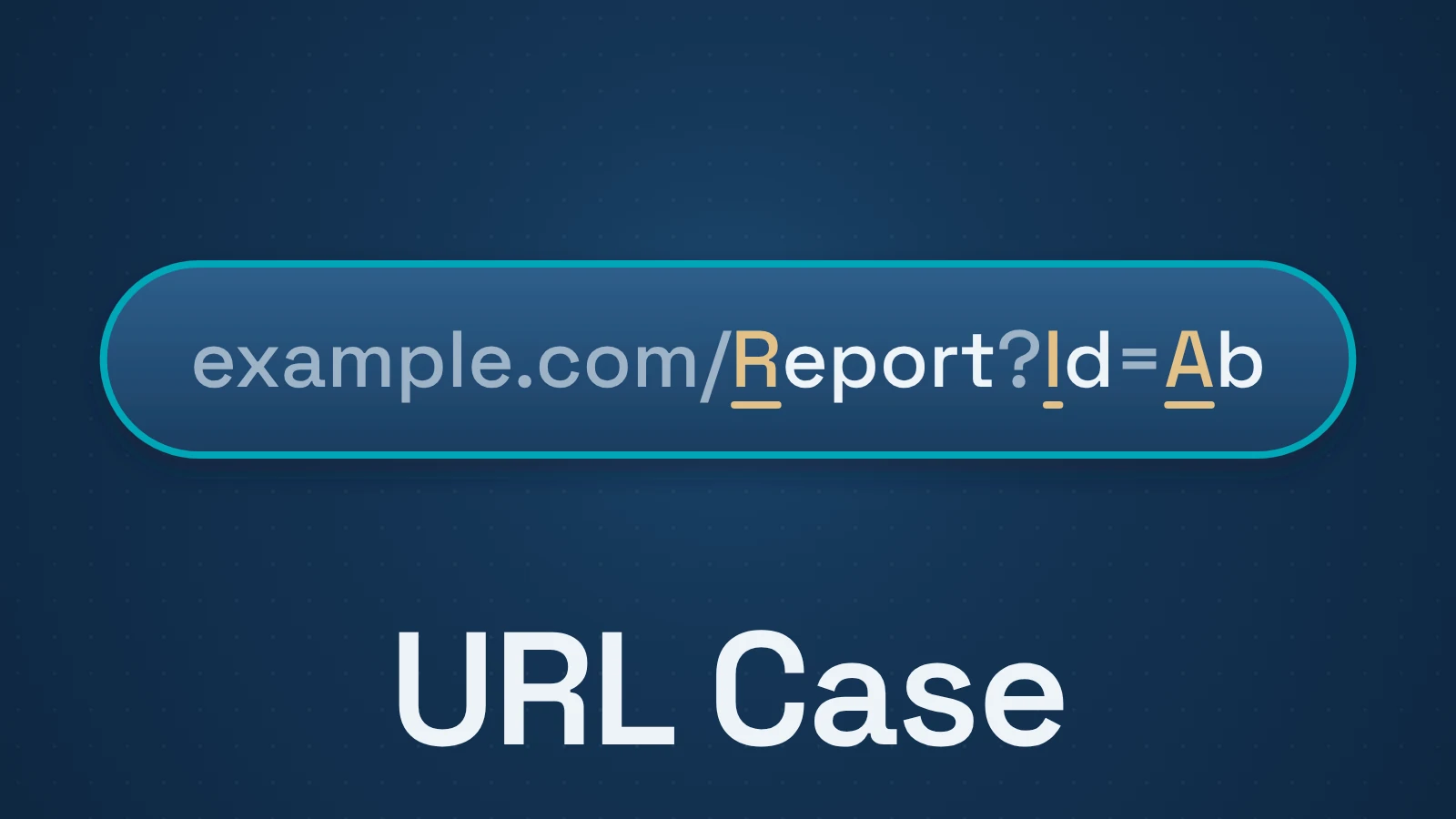
URL schemes and hostnames are case-insensitive under the generic URI rules, while paths and queries can be case-sensitive. Our local test confirmed that a server can handle path case differently without making query keys or values interchangeable. When copying or sharing a link, preserve its original capitalization rather than lowercasing the whole address.
You can often change a domain’s capitalization without changing where a link points. That does not make the rest of the URL safe to lowercase. We sent 24 HTTP requests to a controlled local server and found that changing a path, query key or query value could change a successful response into a 404.
The path result depended on the server’s routing rule. In one mode, Item and item were different. In another, they matched the same route. Query capitalization remained significant in both.
Different parts have different rules
Consider http://localhost/Item?Key=Value. The scheme is http, the host is localhost, the path is /Item and the query is Key=Value. The letters do not all belong to the same component.
RFC 3986’s case-normalization rules distinguish the case-insensitive scheme and host from other components, whose interpretation may depend on the scheme. That is the protocol background. Our experiment then tested what one deliberately configured HTTP server did with paths and parsed query parameters.
We used localhost and plain HTTP. We did not test public DNS, internationalized domain names, HTTPS certificates or every web framework. The generic hostname rule and the scope of the local demonstration are separate facts.
What 24 actual requests returned
The server had two route modes. The exact mode required the path token Item. The folded mode compared the token without case sensitivity. Both modes required the query key Key and value Value with that exact capitalization.
We sent 12 cases to each mode and recorded the URL, actual request target, Host field, status and parsed response. We repeated the complete matrix. The following selected cases show the main differences.
| Case | Exact path mode | Folded path mode |
|---|---|---|
| baseline | 200 | 200 |
| scheme-upper | 200 | 200 |
| path-lower | 404 | 200 |
| path-upper | 404 | 200 |
| query-key | 404 | 404 |
| query-value | 404 | 404 |
| hex-lower | 200 | 200 |
| hex-upper | 200 | 200 |
Our folded path mode accepted item and ITEM, while exact mode returned 404 for both. Changing the query key to key or the value to value returned 404 in both modes. The server recognized the route in those query cases, but its complete success condition still failed.
That distinction matters when interpreting a broken link. A service can be tolerant about one component and strict about another. A single successful capitalization change does not establish that all parts of its URLs are interchangeable.
Percent-encoding has its own case distinction
The hexadecimal letters in an escape such as %6D can be written in either case. In our requests, Ite%6D and Ite%6d decoded to the same Item route token. The server explicitly decoded the path before applying its route rule.
We also kept two cases labeled escape-upper and escape-lower that both used %49. Because that escape contains only digits, those two cases were identical rather than a meaningful upper/lowercase contrast. The full results retain the duplicate instead of presenting it as additional independent evidence.
Changing hexadecimal letter case inside an escape is different from changing the decoded character. Lowercasing the M in a literal path or the V in Value changes the text being interpreted. Preserve that distinction when a tool normalizes URLs.
Should you lowercase links before sharing them?
Keep the original path and query unless you know the destination’s normalization rules. If a link stops working after you retype it, compare those components with the original rather than assuming a shorter or tidier version is equivalent.
Removing a tracking parameter, changing a functional value and changing capitalization are also different operations. A cleaner or shortener needs to preserve the destination semantics that matter to the site. This experiment does not test a named cleaner or provider; it supplies a concrete reason to avoid treating the entire URL as case-insensitive text. A separate study examines what short links preserve in their destinations.
For a site you control, choose a consistent route policy and test links and redirects under that policy. Our two modes demonstrate configurable behavior, without endorsing one universal setting or measuring an SEO ranking effect.
Method and reproducibility
We ran the test on 13 Oct 2026 with Python 3.12.14, a local HTTP server and the standard urllib client. The host was normalized by the parsing/client pathway; the captured Host header could still contain uppercase text. We recorded parser results separately from server-routing results.
The public study package contains the harmless local server recipe, the 24 case records, parser outputs and repetition checks. Port numbers are represented as PORT in the records. No production site, personal browser, credentials or user files were involved.
Download the study files and results (ZIP).
Original fixtures, scripts and study results are available under CC0 1.0; third-party software retains its own licenses.