
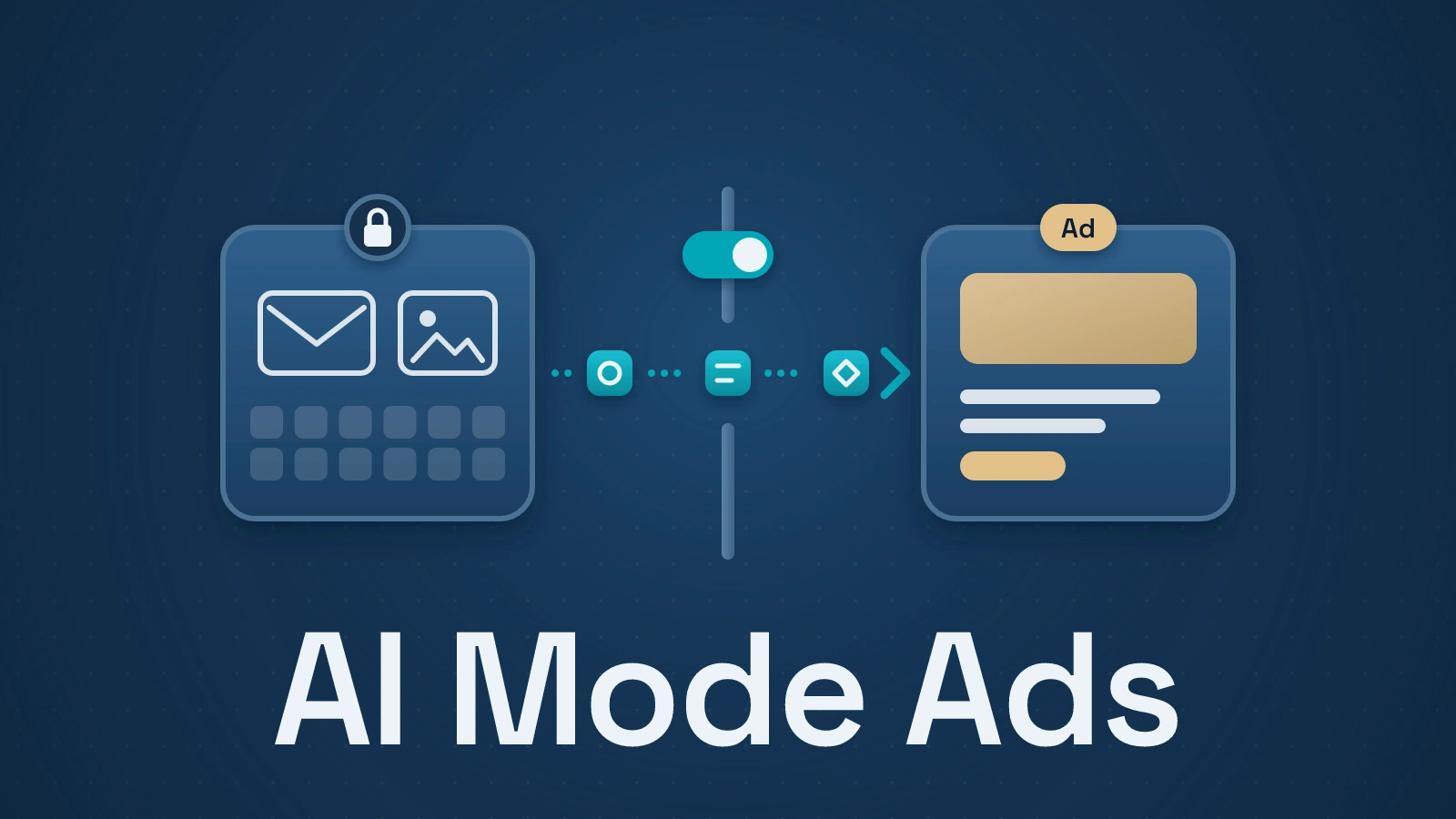
Google is beginning to test ads in the personalized version of AI Mode in Search, including for some people who choose to connect Google apps to its Personal Intelligence features.
Google says ads are not based directly on your full Gmail inbox or Photos library, and advertisers cannot open those collections. Its current help documentation nevertheless says summaries, excerpts and inferences derived from content you choose to connect may be used to personalize ads. That distinction matters when deciding whether Personal Intelligence is worth the additional data access.
Quick answer
If you opt in, yes. Google says information derived from connected Gmail or Photos can help personalize ads in AI Mode. Advertisers cannot access your inbox or photo library, and the ad experiment is limited, not a rollout to everyone. Check your connected-app settings and Search Services History separately.
Contents
- What changed on October 16?
- Can connected Gmail or Photos information influence ads?
- What Google says advertisers cannot see
- AI training and human review are separate questions
- Who is affected—and what can you control?
- What remains uncertain
- What you can do now
- Sources and verification
What changed on October 16?
On October 16, 2026, Search Engine Land reported that Google was beginning to test advertising in AI Mode for people with Personal Intelligence enabled. Google had previously described the connected-app experience as ad-free; the new test introduces ads into that personalized setting. The report describes ad selection as still reflecting the user’s query, the AI response’s context and interests, with insights from connected apps potentially adding another signal.
Google’s current Privacy Policy lists an effective date of October 1, 2026, and says Gmail and Photos content is not used for personalized ads. On October 16, Google added a dated clarification to older public statements about Gmail, Photos and ads. It describes an opt-in exception: if people choose to connect certain content apps to other services, some derived information may help personalize those services and, depending on account settings, the ads they show. The distinction is between the source libraries themselves and information derived through a voluntary connection—not proof of a particular ad’s targeting.
The reported experiment is a test, not proof that every AI Mode user will see the same ads, that the same personalization applies across every country, or that advertisers have received a new tool for selecting people based on particular emails. Google has not detailed the test’s audience size or a broad rollout timetable.
Can connected Gmail or Photos information influence ads?
Yes, with an important condition: the user must choose to connect the relevant content apps to Google Search services. Google’s help page currently explains that Search may use summaries, excerpts and inferences from connected information to personalize its services—and that the same derived information may help determine which ads are shown.
Imagine asking AI Mode for restaurants near a hotel reservation in your email. Google describes using details from connected messages or photos to tailor recommendations. In principle, insights from that request could also inform a relevant advertisement. That is an illustration of the mechanism, not a claim that Google has been observed targeting a particular travel ad from someone’s reservation.
There is another boundary worth knowing. Google describes connecting Google Workspace, currently including Gmail and Google Calendar, and Google Photos to Search services as an opt-in arrangement. Once connected, access is not necessarily restricted to a single AI Mode interaction: the setting covers Search services that include Search, Maps, Shopping and other Google products. The exact available integrations vary by region.
What Google says advertisers cannot see
Google’s published position is that advertisers do not gain access to a person’s Gmail inbox or Google Photos library through this feature. It also says ads are not based directly on the raw contents of those libraries and that its existing restrictions on personalized advertising in sensitive categories still apply.
Those assurances are important, but “advertisers cannot open my inbox” is a different privacy statement from “information derived from my inbox cannot influence an ad.” The second claim would be incorrect under Google’s current connected-app guidance.
AI training and human review are separate questions
Advertising is only one of the possible downstream uses of connected information. Google’s same help page also says it may use interactions, summaries, excerpts and inferences based on connected content to improve services, including training generative AI models. It says models are not trained directly on entire Gmail inboxes or Photos libraries, but adds that an excerpt or summary can sometimes resemble the original brief message or file.
Google also describes limited human review of processed interactions for quality and safety, subject to its stated privacy-reduction measures. These are separate disclosures from the October 16 ad test; neither should be conflated with the claim that advertisers can read private emails. If you keep sensitive or confidential information in connected apps, the training and review disclosures deserve attention in their own right.
Who is affected—and what can you control?
The connected-app functionality is optional, and availability depends on location, language, account eligibility and the particular app. Google says some settings are in transition, so labels and steps may differ from what appears in your account. A reader should not assume that Personal Intelligence, a Gmail smart-features toggle and ordinary Google ad personalization are all the same switch.
To check your exposure, open your Google Account’s Search Services Personalization settings, review Personalized Recommendations and the Additional Personal Intelligence / Connected Content Apps area, and see whether Google Workspace or Google Photos is actually connected. Google’s instructions describe disconnecting apps from this area. Some Workspace experiences also require separate Gmail smart-features settings. Follow the current help instructions rather than assuming a menu will appear identically on every device.
Disconnecting an app stops that ongoing connection, but Google warns that it does not automatically delete information already saved in Search Services History. That history has its own management and deletion controls. Changing a connection setting also does not mean all ordinary Google ad personalization is disabled.
What remains uncertain
As of October 17, 2026, Google’s current policy/help text describes permitted uses of connected-app information, and October 16 reporting confirms that an AI Mode ad test is beginning. Neither establishes how many people are in the test, which exact derived signals are used for a particular impression, whether every eligible country is included, or whether most users will find the settings available.
Nor have we independently tested an account in the new advertising experiment. Descriptions above distinguish Google’s documented policy and third-party reporting from observed behavior; there is no claim that we measured real ad targeting or audited Google’s internal access controls.
What you can do now
If you want AI Mode to use travel plans, past purchases or other personal context, connected apps may make answers more convenient. But the trade-off is larger than a smarter response: Google’s current documentation says information derived from those connections may also contribute to advertising personalization and, under stated conditions, product improvement and model training.
The practical choice is to review the connection itself, not merely whether an AI answer looks helpful. Connect only apps whose information you’re comfortable using under those terms—and disconnect them if that balance no longer works for you.
Sources and verification
- Search Engine Land, “Google begins testing ads in AI Mode for users with Personal Intelligence enabled,” October 16, 2026.
- Google Search Help, “Connect your Google content apps to get a Search services experience that’s tailored to you,” reviewed October 17, 2026 (page text is subject to ongoing changes).
- Google Privacy Policy, effective October 1, 2026 (date displayed on the current policy page when checked October 17).
- Google, “New settings for smart features and personalization in Gmail,” October 2020, updated October 16, 2026 with an explicit connected-app advertising clarification.
- Google Search Help, “Find & manage Search Services History,” reviewed October 17, 2026.